A laptop that won't turn on when you press the power button can be alarming, especially if you rely on it for work, study, or business. While many people assume the motherboard has failed, the issue is often caused by a faulty power button, damaged power button cable, battery problems, charging issues, or a malfunctioning power management circuit. In some cases, technicians can temporarily "jump-start" the laptop by bypassing the power button to determine whether the fault lies with the button itself or the motherboard.
In this guide, you'll learn why laptop power buttons stop working, how technicians safely diagnose the issue, when jump-starting is used for testing, and when professional repair or motherboard service is required. At Guru Computer Solution, we provide expert diagnostics and chip-level repairs for laptops of all major brands.
Problem
A non-responsive power button prevents the laptop from turning on, even when the charger is connected and the battery appears charged. Some laptops show no signs of life, while others display charging indicators but fail to power up when the button is pressed.
Since the power button is connected to the motherboard through a dedicated circuit, the problem may be caused by the button itself, a damaged flex cable, the embedded controller (EC), charging circuitry, BIOS issues, or motherboard faults. Proper diagnosis is essential before replacing any components.
What Problem Is the Customer Facing?
Customers often report that pressing the power button has no effect. The laptop may not light up, the cooling fan may never start, and the display remains black. In some cases, the charging LED turns on, but the laptop still refuses to start. Others may notice the power button feels loose, gets stuck, or only works after being pressed repeatedly.
Because these symptoms can originate from several different hardware components, replacing the power button without proper testing may not solve the issue. Professional diagnostics help determine whether the fault lies with the power button assembly, battery, charging system, BIOS, or motherboard.
Root Causes of the Problem
A laptop power button may stop working due to several reasons, including:
- Worn or damaged power button switch
- Faulty power button flex cable
- Loose internal connector
- Liquid damage near the power button
- Physical impact or accidental drops
- Embedded Controller (EC) failure
- BIOS corruption
- Faulty charging IC
- Dead or deeply discharged battery
- Defective AC adapter
- Motherboard power circuit failure
- Damaged MOSFETs or power ICs
- Short circuit on the motherboard
- Corrosion caused by moisture
- Failed Super I/O chip
How Can Customers Identify the Issue?
Common symptoms include:
- Power button does nothing
- Laptop won't turn on
- No display after pressing the power button
- No fan spin
- No keyboard backlight
- Charging light is on but laptop won't start
- Power button feels loose or stuck
- Laptop starts only after multiple attempts
- Power LED flashes briefly then turns off
- Laptop randomly powers off
- Burning smell near the power circuit
- Power button works intermittently
Possible Solutions
1. Check the Charger and Battery
Before assuming the power button has failed:
- Test with a compatible charger.
- Check for charging indicator lights.
- Remove and reconnect the battery (if removable).
- Perform a power reset by holding the power button for 20–30 seconds.
2. Inspect the Power Button
Technicians inspect the button for:
- Physical damage
- Sticking mechanism
- Broken switch
- Worn contacts
- Damaged flex cable
If only the switch is faulty, replacing the power button assembly usually resolves the issue.
3. Jump-Start the Laptop (Professional Diagnostic Method)
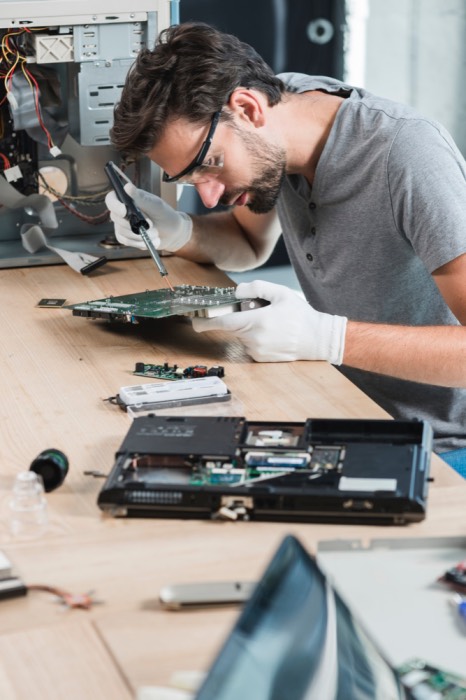
If the power button is suspected to be faulty, technicians may temporarily jump-start the motherboard by shorting the designated power-on pins using professional tools and manufacturer-approved procedures.
This diagnostic method helps determine whether:
- The motherboard powers on normally.
- The power button or cable is defective.
- The issue lies elsewhere in the power circuit.
Important: Jump-starting a laptop should only be performed by trained technicians. Incorrectly shorting motherboard contacts can permanently damage the board or create electrical shorts.
4. Test the Charging Circuit
If jump-starting fails, technicians inspect:
- DC charging jack
- Charging IC
- Power MOSFETs
- Input voltage rails
- Battery charging circuit
5. Reset or Recover BIOS
Corrupted BIOS firmware can prevent the embedded controller from responding to the power button. Resetting or reprogramming the BIOS may restore normal operation.
6. Motherboard Repair
Advanced chip-level repair may be required if diagnostics reveal:
- Power IC failure
- Super I/O chip failure
- Embedded Controller malfunction
- Short circuit
- Burnt motherboard components
- Damaged power management circuitry
Why Choose Guru Computer Solution?
1. Certified Technicians
Our experienced engineers specialize in diagnosing laptop startup and power-related issues using professional testing equipment.
2. Genuine Parts
We use high-quality replacement power buttons, flex cables, and compatible motherboard components.
3. Fast Turnaround
Most power button repairs and diagnostics are completed quickly to minimize downtime.
4. Warranty Support
Eligible repairs and component replacements include warranty support for your peace of mind.
5. Affordable Pricing
We provide transparent pricing and repair only the components that need replacement, helping you avoid unnecessary costs.